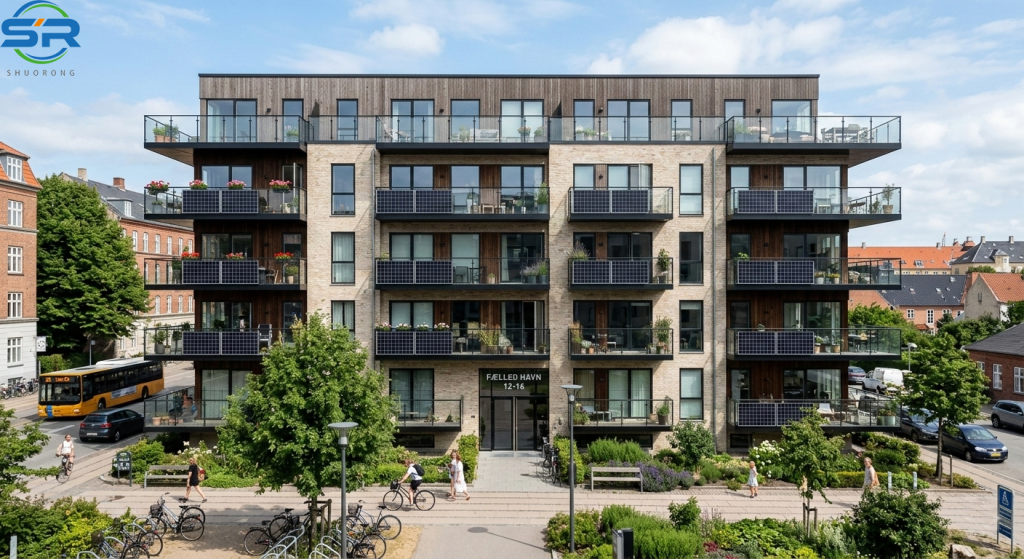
Have you walked through a European city lately? From the sleek glass towers of Frankfurt to the classic lattice balconies of Paris, there’s a quiet green army taking over. We’re talking about balcony solar. For years, this was the playground of DIY enthusiasts, but as we roll into 2026, the game has changed. Balcony mounting brackets in Europe have evolved from “clunky metal bits” into high-performance structural components that EPCs (Engineering, Procurement, and Construction) and distributors are snapping up by the container-load.
At SR Solar (SR), we’ve seen this transition firsthand. The conversation has shifted from “Can I do this?” to “How fast can we install 500 units in this apartment block?” If you’re a distributor, you’re not just selling a bracket; you’re selling safety, compliance, and speed. Let’s get into why this vertical market is the most exciting place to be right now.
The “Vertical Solar” Shift: Why Your Clients Want This Now
From Niche Hobby to 800W Household Appliance
Remember when installing solar on a balcony felt like a legal gray area? Those days are gone. Thanks to the 2024 Solar Package I and subsequent 2026 updates, Germany and much of the EU have officially raised the inverter limit to 800W. More importantly, these systems are being reclassified as “household appliances.” That’s a massive psychological shift for your customers. It means solar is now as “normal” as a toaster or a microwave.
But here’s the kicker for B2B players: while the system is easy to plug in, the mounting is where the liability lives. You can’t just hang a 25kg glass module with zip ties and hope for the best. That’s why professional-grade balcony mounting brackets in Europe are seeing a 40% year-over-year growth in the commercial sector. People want the “plug-and-play” ease, but they want the “industrial-strength” peace of mind.
The Urban Landlord Logic: Lower Barriers, Higher Adoption
If you’ve ever dealt with European landlords, you know they can be… let’s say, “protective” of their buildings. For a long time, the fear of structural damage or “ugly” installations blocked the market. But the latest balcony mounting brackets in Europe are designed to be non-intrusive. SR’s designs use friction-mounts and protective gaskets that leave zero marks. When a tenant moves, the solar plant goes with them, and the balcony looks exactly like it did on day one. This “renter-friendly” approach has opened up millions of households that were previously off-limits to solar.
Engineering for the “Venturi Effect”: Safety in High-Rise Europe
Dynamic Wind Load and the Level 16 Gale Test
Let’s get real for a second. A balcony on the 10th floor is a wind tunnel. You’ve got the “Venturi effect,” where wind speeds up as it’s squeezed between buildings. If your bracket isn’t engineered for dynamic loads, that solar panel becomes a very expensive, very dangerous sail.
At SR Solar, we don’t just “guess” the strength. Our mounting systems are tested to withstand Level 16 gales—that’s nearly 200 km/h. We use reinforced hook systems and vibration-dampening gaskets to ensure that even during a North Sea storm, those modules stay exactly where they belong. When you’re pitching to a property developer, being able to show wind-load certification isn’t just a “nice to have”—it’s the thing that closes the deal.
Material Science: Why AL6005-T5 Beats Steel Every Time
I often get asked, “Why not just use cheap galvanized steel?” Well, if you want your brackets to start rusting after three winters in rainy Brussels, go ahead. But for a 25-year investment, we stick to AL6005-T5 Aluminum.
Why? It’s the sweet spot of strength-to-weight ratio. It’s light enough for a single technician to carry up three flights of stairs, but tough enough to resist the “galvanic corrosion” that happens when different metals touch in humid air. Plus, we pair it with SUS304 stainless steel hardware. It’s about building something that looks as good in year 20 as it did in week one.
Navigating the Chaos of European Railing Standards
Universal Hook Systems: Lattice vs. Concrete Solutions
If Europe had one single balcony design, my life would be much easier! But between the round handrails in Italy and the thick concrete parapets in Spain, “one size fits all” usually means “one size fits none.”
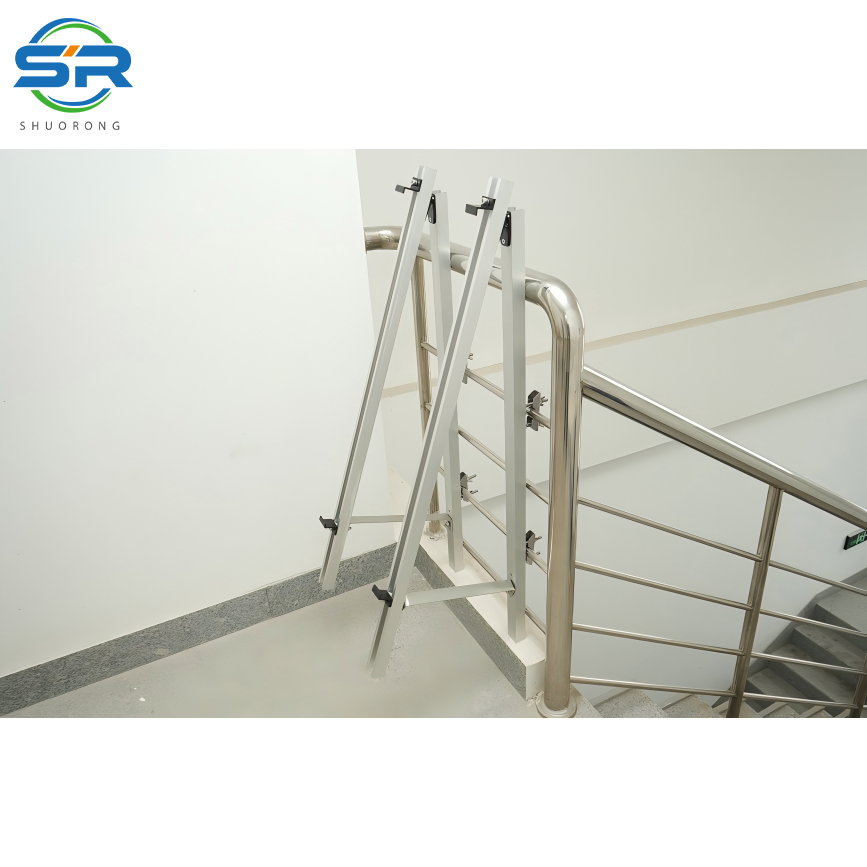
This is where the SR “Modular approach” shines. We’ve developed universal railing clamps that adjust for round rails up to 50mm and square ones up to 80mm. For the EPC, this is a lifesaver. You don’t need to carry five different SKUs in your van. One kit, one solution.
Zero-Drill Innovation for Heritage and Glass Balconies
What do you do when the balcony is made of tempered glass or is a protected historical site where you can’t drill? You get creative with tension. Our latest 2026 designs use floor-to-wall ballasted frames or high-tension friction mounts. These systems use the weight of the module and the geometry of the bracket to create a rock-solid grip without a single screw entering the building’s envelope. It’s a game-changer for high-end apartment retrofits where “no-drill” is a hard requirement.
Profitability in the Details: Pre-Assembly and Labor Costs
In the B2B world, your biggest enemy isn’t the competition—it’s labor hours. If a technician spends two hours fiddling with nuts and bolts on a single balcony, your margins are toasted.
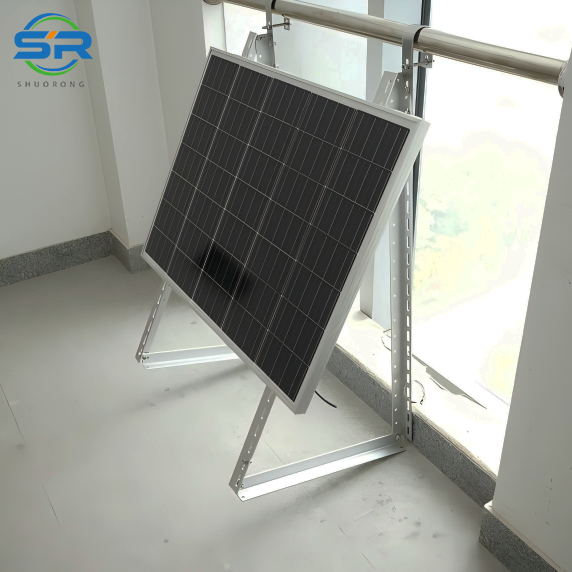
That’s why we ship SR Solar balcony kits 95% pre-assembled. We’re talking “snap-to-lock” technology. In our internal tests, we’ve seen installation times drop by 60%. A single technician can set up a dual-panel system in about 15 minutes. When you’re doing a 50-unit project, those saved hours turn directly into profit. Plus, our kits are lightweight (around 2.1kg to 5kg per set), meaning you don’t need heavy lifting gear. It’s “solar for the masses” with “industrial efficiency.”
Regulatory Compliance: VDE-AR-N 4105 and the 2026 Standards
Let’s talk paperwork—boring, but essential. As of early 2026, the EU has tightened the screws on safety documentation. Whether it’s Germany’s VDE-AR-N 4105 or the broader Energy Performance of Buildings Directive (EPBD), your hardware needs to be compliant.
When you buy balcony mounting brackets in Europe from SR, you’re getting systems that are already CE certified and tested against the latest AS/NZS equivalents. We provide the full engineering calculation reports. If a property manager asks for proof that your panels won’t fall on a pedestrian’s head, you can hand them a professional document. That level of transparency is how you build trust in a crowded market.
Conclusion: Elevating Your Business with SR Solar
The “Vertical Solar” market in Europe isn’t a trend; it’s a structural shift in how we power our cities. By choosing the right balcony mounting brackets in Europe, you’re positioning your business as a leader in safety and efficiency. At SR Solar, we’re not just manufacturing hardware; we’re building the backbone of the urban energy transition. Whether you’re an EPC looking to slash installation times or a distributor wanting a “zero-callback” product, we’ve got your back.
Let’s turn those empty balconies into power plants, shall we?
FAQs for European Solar Distributors
1. Are these brackets compatible with the new 550W+ large format modules?
Absolutely. While many older brackets were built for 300W panels, SR Solar brackets are engineered for the weight and surface area of modern 400W–550W modules. We’ve beefed up the load-bearing points to ensure there’s zero “flex” even with larger glass-glass panels.
2. How do SR Solar brackets handle the different railing shapes across Europe?
We use a modular hook system. Our standard kit includes adjustable clamps that fit round, square, and oval handrails. For concrete parapets, we offer a specialized “over-the-wall” hook that distributes weight across the top and side of the wall without needing to drill.
3. Is there a risk of the brackets damaging the balcony’s paint or finish?
No, we’ve thought of that. Every contact point on our balcony mounting brackets in Europe is fitted with high-grade EPDM rubber gaskets. These provide a “soft touch” that prevents scratching and also acts as a vibration dampener to keep the system quiet during high winds.
4. Can the tilt angle be adjusted after the panels are installed?
Yes! Most of our kits feature a tool-free adjustment mechanism. You can set the angle between 15° and 30° to catch the low winter sun in Northern Europe or the high summer sun in the South. This flexibility can increase energy yield by up to 15% compared to flat-mounted panels.
5. Do I need a professional electrician to install the brackets?
In many jurisdictions (like Germany under the 800W rule), the electrical connection is plug-and-play. However, for large-scale B2B projects, we always recommend professional installation to ensure the structural mounting meets local building codes. Our pre-assembled design makes this “pro” installation faster than ever.